


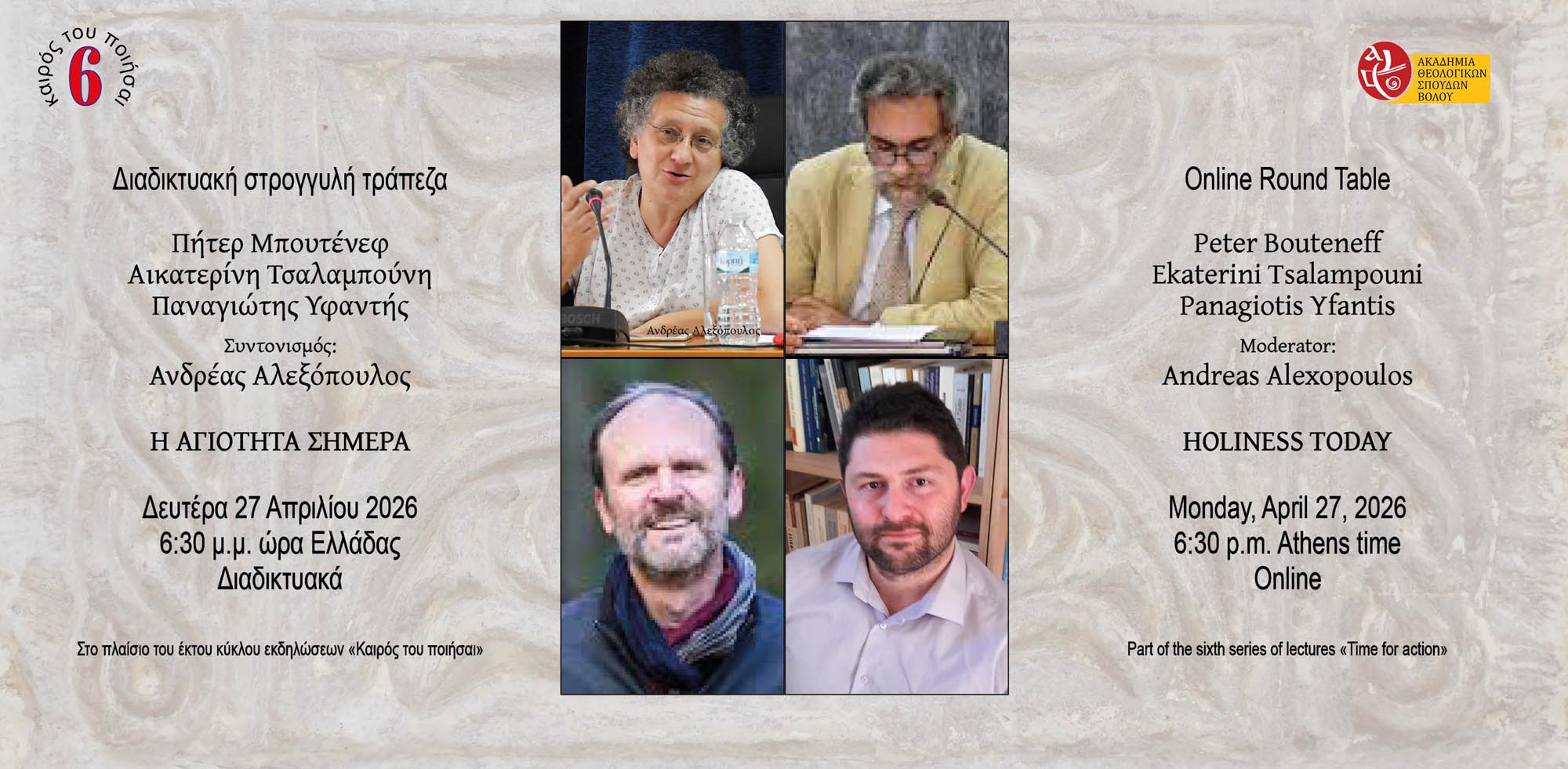
Online Round Table
HOLINESS TODAY
Monday, April 27, 2026, 6:30 p.m. EEST
The next event in the series “Time for Action” of the Volos Academy for Theological Studies, will take place on Monday, April 27, 2026, at 6:30 p.m. Athens time (EEST) and its topic will be “Holiness Today”. Speakers include Prof. Dr. Peter Bouteneff, Professor of Systematic Theology and Kulik Professor of Sacred Arts at the St Vladimir’s Orthodox Theological Seminary (New York, USA); Prof. Dr. Ekaterini Tsalampouni, Professor of New Testament in the Faculty of Theology of the Aristotle University of Thessaloniki; and Prof. Dr. Panagiotis Yfantis, Professor of Patrology and Hagiology in the same University. The event will be moderated by Dr. Andreas Alexopoulos, Research Associate of the Volos Academy and Post-Doctoral Researcher in the National University of Athens; its languages will be Greek and English with simultaneous interpretation. The round table will be accessible online via Zoom at https://us06web.zoom.us/j/89965865933.
As a first step, the webinar will examine the concept of holiness in the modern world and the way in which it is expressed in the daily lives of believers. Common to most religious life is the understanding that we human beings are flawed, and that we are liable to think and do wrong. Classical Christian tradition pulls no punches when it comes to expressing what that means for me and for my plight as a human being. In our regular set prayers, we call ourselves “sinners,” “wretched,” “pitiful,” and “worthy of condemnation.” This language can sound odd or extreme to many sensibilities, yet there it is, front and center. If we accept that we are sinners, what does it means today for our identities and social life, in relation to our vocation towards holiness?
In the next part, discussion will focus on holiness in the Old Testament texts and it will trace the new semantic dimensions of holiness in the New Testament, and especially in Paul, who detaches holiness from its Old Testament cultic-liturgical dimension and elevates it to an ecclesiological category with Christological reference and eschatological horizon: the designation “hagios” no longer defines a ritual space or condition, but a new ethos of life in Christ, which characterizes the ecclesial community and shapes the relations among its members.
Finally, there will be an attempt for a critical approach to the hagiological models that dominate the Orthodox Church today. The social map composed by recent and current canonizations based on gender, age, position or office in the ecclesiastical organization, etc., reveals the spiritual tendencies and anthropological priorities of the ecclesiastical organization as a whole and, consequently, it outlines its extreme controversies in terms of its biblical consistency and anthropological capacity.
Peter Bouteneffteaches courses in ancient and modern theology and spirituality at St Vladimir’s Orthodox Theological Seminary (New York, USA), where he is professor of Systematic Theology and Kulik Professor of Sacred Arts. After his doctoral studies at Oxford University in patristics, he worked for many years in theological dialogue, notably as executive secretary for Faith and Order at the World Council of Churches. He has written extensively on Orthodox relations with other churches including on the Eastern Orthodox-Oriental Orthodox Dialogue. His latest book on the subject is entitled “Union Without Confusion: Councils and Christology Beyond the Chalcedonian Divide.”
Ekaterini Tsalampouni is Professor of New Testament at the Department of Social Theology and Christian Culture, Faculty of Theology, Aristotle University of Thessaloniki. Her research focuses on New Testament exegesis and theology and the Graeco-Roman context of the New Testament. She studied at the Faculty of Theology in Thessaloniki and continued her postgraduate studies in Heidelberg. In 1999 she defended her doctoral thesis titled “Macedonia in New Testament times”. She is a member of several academic societies: Society of Biblical Literature, European Association of Biblical Theology, Colloquium Paulinum etc. She is a member of the board of the Hellenic Bible Society and the Volos Academy of Theological Studies. Her publications include “Macedonia in New Testament Times” (2002), “Ecology and the New Testament: Method and Examples” (2013), “The Spirit as a Hermeneutical Lens of Israel's Past and the Church's Present and Future: 2 Cor 3:16-17 and its Reception in Patristic Tradition” (2019), “Sola Scriptura: A Greek-Orthodox Perspective”(2019) etc.
Panagiotis Yfantis (b. 1966) studied Theology in Athens, continued with postgraduate studies in Italy and got his PhD in Thessaloniki with a thesis on the spiritual and theological physiognomy of saint Francis of Assise. In 2005 he was elected a lecturer in the Department of Theology of the Aristotle University of Thessaloniki, where he continues to work to this day as a Professor of Patrology and Hagiology. Moreover, from 2008 he teaches Orthodox Theology as a visiting professor in Catholic Universities of Ecumenical Studies in Venice and in Bari, Italy. He has published books and articles of patristic, hagiological, and ecumenical content in Greek and Italian. In addition, he has translated into Greek texts of early mendicant orders, scientific works, essays, and literature. Among his publications “The sanctity of martyrdom and the testimony of sanctity. Theological studies” (2009), “Battle of Reconciliation. Man, fellow man, Godman in the arenas of theosis” (2018) etc.

.jpg)
