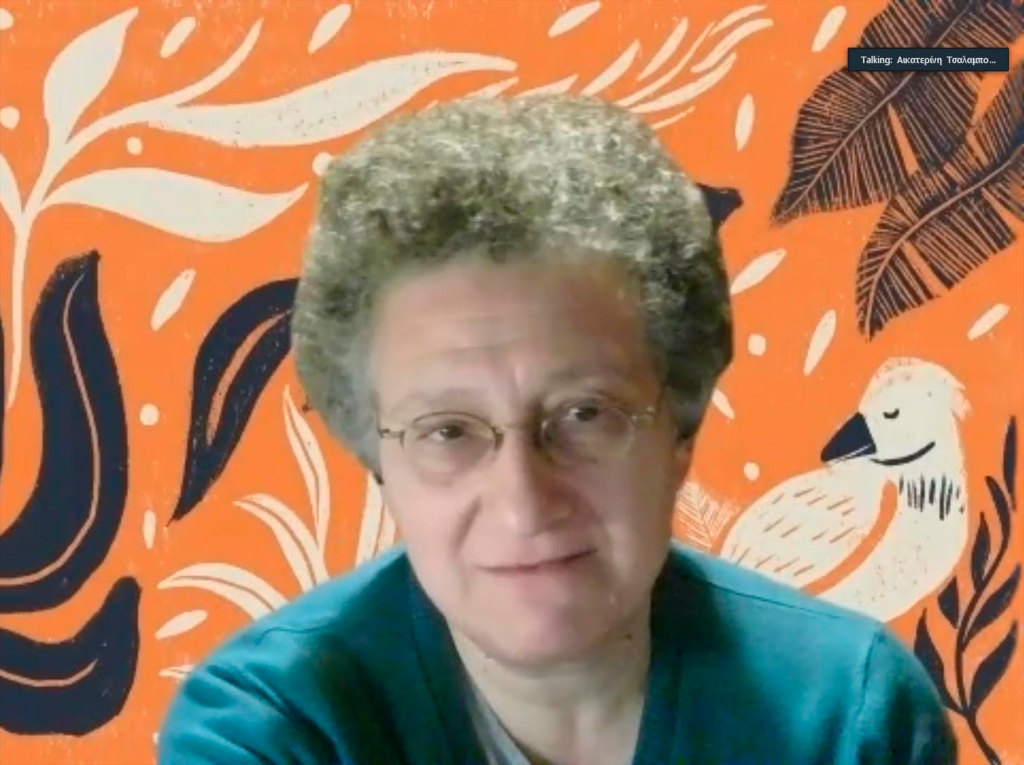
Completion of online lecture
Ekaterini Tsalampouni
CHRISTIAN APOCALYPTIC TEXTS AND CLIMATE CHANGE:
A PROPOSAL FOR CRITICAL ECOLOGICAL BIBLICAL INTERPRETATION
Part of the second cycle of lectures “Time for Action”
by Volos Academy for Theological Studies
The online lecture of Ekaterini Tsalampouni, Associate Professor of the Aristotle University of Thessaloniki, on “Christian apocalyptic texts and climate change: a proposal of ecological critical biblical interpretation” was successfully held on Wednesday, February 23, 2022. This lecture was the third in the “Time for Action” series organized by Volos Academy for Theological Studies in 2022, and it was delivered in Greek with interpretation into English. The event was moderated by Christos Karakolis, Professor of the Faculty of Theology at the National Kapodistrian University of Athens.

The speaker presented the various types of apocalyptic literature, emphasizing the dimension of optimism with which the presumed end of the world has been taken up at times, either as a dispensation of divine justice or as a promise of a better world in replacement of the current one, which is perceived as corrupt and declining. She distinguished between types of apocalyptic literature and analyzed passages of the Bible featuring an eschatological perspective, showing the differences between apocalyptic eschatology (where the restoration of the relationship with God is placed beyond history) and prophetic eschatology (where this restoration is anticipated to take place within history), and she warned about the fact that the Bible is often approached in a fragmentary way, resulting in major misinterpretations. At the same time, she referred to the social and cultural profile of Christian and Jewish groups associated with eschatological approaches, and spoke about the prospect of the restoration of the whole universe in the final times, in a less anthropocentric biblical interpretation.

In the interesting discussion that followed, there were questions about the possibility of a multifaceted rather than an univocal interpretation of the Bible, about the resurrection of the dead and the eternal hell as eschatological perspectives, about the relations between protology and eschatology, and finally about the possible existence of a symbolic language in Revelation, similar to the one which is thought to be used in the Bible, describing the creation of the world.
A video of the event, along with the discussion, has already been posted on the Volos Academy of Theological Studies YouTube channel, you can watch it here:
The next event in the “Time for Action” series will take place on Thursday, March 10, with the author Stelios Ramfos as speaker. The topic will be “How Greek is Byzantium?”