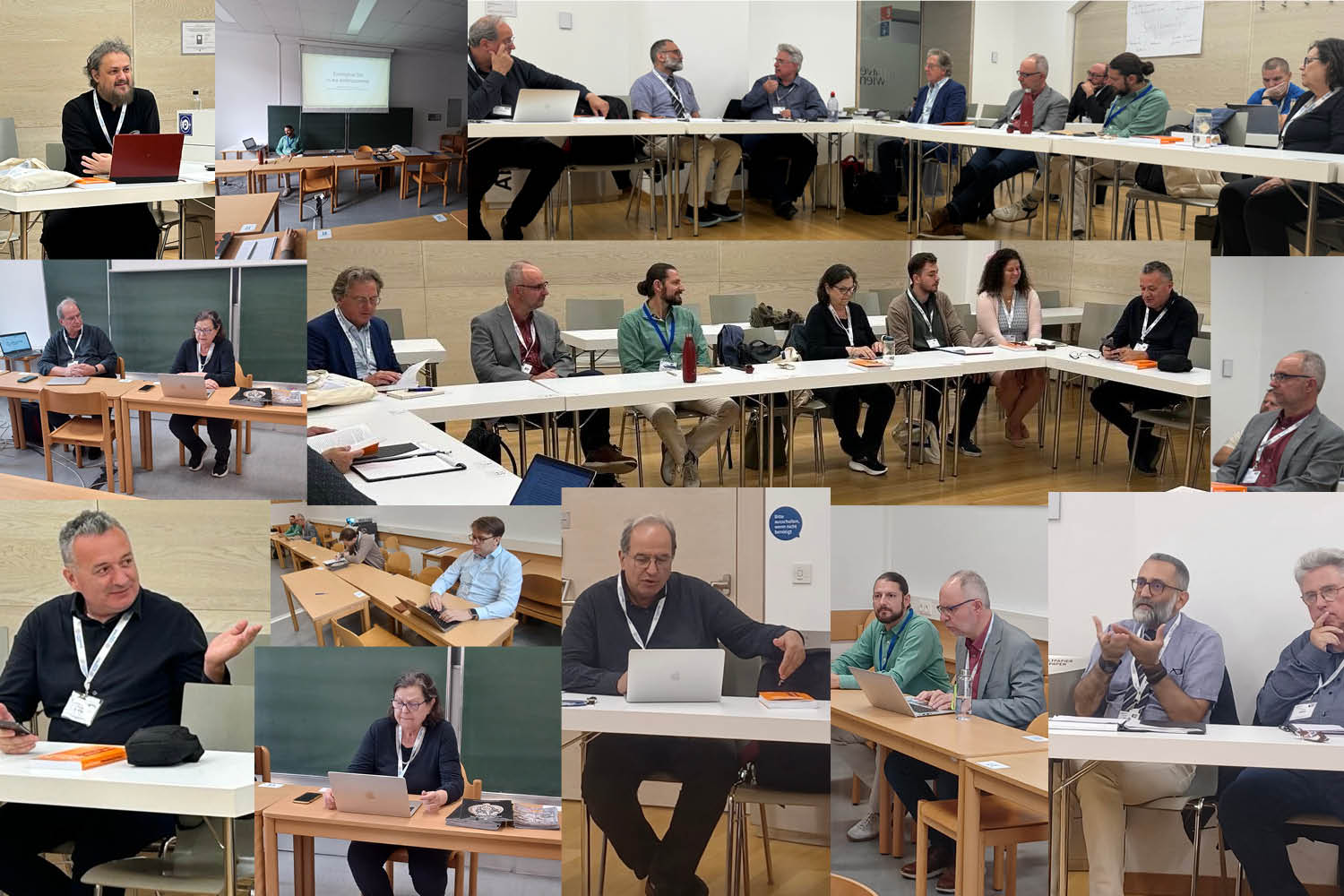
Volos Academy for Theological Studies participated in the Eighth Annual Conference of the European Academy of Religion, which was held in Vienna, Austria, between July 8 and 12, 2025, with two sessions.
The first session, entitled “Remembering the Future: John Zizioulas’ Eschatological Vision,” offered a rich and animated reflection on the eschatological theology of the late Metropolitan of Pergamon, John Zizioulas. It was co-organized by the Volos Academy for Theological Studies and the St. Sebastian Press from Los Angeles, CA. The session focused on Zizioulas’ final and posthumously published work, “Remembering the Future: Towards an Eschatological Ontology” (2023). In this seminal book, Zizioulas argues that eschatology is not merely a future doctrine, but an existential orientation—an active lens through which the Church understands history, ethics, community, and its very being. The panel was chaired by Dr. Nikolaos Asproulis, deputy director of the Volos Academy. He convened the session with theological clarity and pastoral sensibility, opening the floor for an invigorating exchange. The featured speakers included Bishop Maxim (Vasiljević) of the Diocese of Los Angeles, CA, and Adjunct Professor of Dogmatics and Patristics at Holy Cross Greek Orthodox School of Theology in Boston, MA, USA; Dr. Pantelis Kalaitzidis, Director of the Volos Academy; and Prof. Dr. Najib George Awad, Associate Researcher at Bonn University, Germany.
Bishop Maxim explored how Metropolitan John redefines ethics through an eschatological ontology, grounding moral action in the future Kingdom inaugurated by Christ’s resurrection. Unlike traditional ethics based on nature or reason, his approach offers a dynamic, forward-looking framework. Dr. Kalaitzidis focused on the future-oriented reading of tradition in Zizioulas’ theology, highlighting how this hermeneutical approach could be applied to contemporary issues such as the interpretation of tradition and the ordination of women. Prof. Awad, in turn, explored resonances between Zizioulas and other Trinitarian thinkers, particularly Colin Gunton, emphasizing their shared commitment to dialogue, relationality, and particularity, and seeking to uncover possible hidden connections between the two theologians, especially in their theological method and vision. The discussion was marked by a spirit of genuine theological inquiry. Many questions were raised from the audience—ranging from the practical implications of eschatology in modern life to the relevance of liturgical experience as a foretaste of the Kingdom. The panelists engaged openly, offering thoughtful and inspiring responses.
The second session had the title “Orthodox Christian Theologians, Scholars, and Clergy Address the Ecological Crisis and Changing Religious and Socio-Cultural Landscapes” and it examined Orthodox Christian theology and symbolic meanings encoded in Orthodox Christian theological discourses, liturgical life and material culture as they relate to promoting social cohesion and human solidarity in the face of global warming and climate change manifested in wildfires, floods, droughts, heatwaves, and polluted natural resources giving way to the loss of human life and the destruction of human settlements and ecosystems throughout the globe. Panelists examined themes articulated in contemporary Orthodox theological discourses and practices that speak to the environmental crisis applicable to Christians, faith communities, and secular groups seeking sources to guide personal and collective thinking, reflection, and action to mitigate global warming resulting from human production and consumption patterns that rely on excessive use and dependence on fossil fuels. The panel aimed to generate discussion on the role of Orthodox theology and Christians to meet this historical moment in which people throughout the world face human-induced climate catastrophes threatening the future of the planet.
Prof. Frances Kostarelos (Governors State University, Chicago, IL, USA) explored how Orthodox eco-theological sources can inspire personal and social transformations needed to rethink and reimagine self-destructive cultural, social, and economic systems that upend the natural order on which life on Earth depends. She reflected on how the Orthodox Church must use theological sources to cultivate the capacity to work collaboratively with faith-based and secular groups to develop just and sustainable social, economic, and ecological systems. Prof. Christopher Durante (St. Peter's University, New Jersey, NJ, USA) adopted the view that a defining feature of the Anthropocene era has been humanity’s “ecological sinfulness.” Starting from the assumption that the root cause of our ecological sinfulness is our collective egoism as human beings, the speaker suggested that ecological sin is primarily a collective and systemic form of sin. He argued that our species-wide failure to relate properly to the natural world results from our global civilization’s misperception of humanity’s relationship with natural creation. He concluded by exploring practical ways for humanity to engage in repentance for our ecological sinfulness, proposing methods to develop a more ecologically virtuous mindset. The last speaker, Dr. Nikolaos Asproulis (Volos Academy), presented a sketch of a new model of doing theology today in light of the climate crisis, called Eco-Dogmatics. According to him, "eco-dogmatics" is not a new chapter of theology or a new version of creation theology, but rather a new approach that seriously considers the achievements of ecology, utilizing tools and means to present core doctrines of the tradition in a new way. After exploring several methodological prerequisites of eco-dogmatics, such as the language of ontology and the role of hermeneutics, he highlighted deep Christology as a central pattern of eco-dogmatics to illustrate how a theology deeply informed by the climate crisis should look. The panel was moderated by Dr. Pantelis Kalaitzidis, director of the Volos Academy.